God and Butterflies

Share

Giant SwallowtailIt was just laying there on the sidewalk—a big, beautiful butterfly. Papilio cresphontes; Giant Swallowtail, as we learned later.

My wife was walking our dog when she saw the butterfly on the ground. It didn’t move when she bent down for a closer look, and so, thinking it was dead, she wanted to bring it home and preserve its beauty. Until it hopped a few inches away.

She tried again. Again, it hopped away. Obviously not dead, but was it only a matter of time? A couple more tries, a couple more hops, and then… the wings stretched out in that groggy, not-quite-awake kind of stretching we do when we’re struggling to rise too late out of a too-deep sleep.

The beautiful black and yellow wings carried the Papilio a few feet more before one final burst of life lifted him into the air to do what butterflies do: grace the air with the lightness of a falling leaf, the tiptoed dance of a ballerina on the stage.

Mesmerized, my wife realized what she’d been hearing in the podcast coming through her earbuds: Look at the birds (or the butterflies). They don’t plant or harvest or store away any food for tomorrow, for your heavenly Father feeds them. And aren’t you more valuable to him than they are?

On this day, God wanted that Giant Swallowtail to fly again—and to demonstrate his love to my wife. She needed that. So did I.

But something else also struck me as she shared this. That butterfly had seemed nearly dead, and it probably was. Sometimes that’s how we feel, too. Life has beaten on us for so long that we almost can’t take it anymore. Getting out of bed is exhausting. Getting the kids to school, buying groceries, making dinner… the most normal, uneventful parts of life threaten to unravel us.

We’ve faced death and loss and grief and hopelessness for so long, all we can do is lay down like that butterfly.

But like that butterfly, I think God wants us to fly again. It may take a few frightened hops, some groggy stretching of our wings… but I think we’ll get up in the air. And someone watching—like my wife with that butterfly—will see us and praise God. And maybe they’ll get up in the air again, too.

On Life and Death

Share

Morgan on Walden Pond

I went to the woods because I wished to live deliberately, to front only the essential facts of life, and see if I could not learn what it had to teach, and not, when I came to die, discover that I had not lived. – Henry David Thoreau

I found myself these past two weeks reflecting more than usual on life and death. First, because my father—three months shy of his 80th birthday—was having one of those surgeries that is far more involved than the ninety minute time frame would suggest; a surgery that has become almost routine (more than a hundred performed each year in this hospital alone) but could go mortally wrong in an instant; a surgery that is merely a precursor to another, which is at the same time far more complex and far less risky. At least, that’s my non-medical perception.

But my reflection has also been inspired by my son, who turned 21 last week—an age at which he may now do almost anything legal other than rent a car from a major agency. He’s also had his run-ins with death, beginning in the first moments of his life when his bluing skin and an infant oxygen tent made me eternally grateful for the calm confidence of the delivery-room nurses. Two-thirds of his life later, he spent two weeks in the hospital for an appendectomy that in many cases would be an outpatient procedure; we, on the other hand, were told not less than five times in three days, “this is serious; he could die.”

And here I am, gratefully positioned between a father and a son who both have taunted death time and again—my dad, until last year, on snow skis at 12,000′; my son on the rugby pitch for a couple years and now on boulders and climbing walls wherever he can find them.

Facing death, I’ve found—even as but a slim possibility—is made easier when life has been fully lived. That’s what took Thoreau to his cabin on Walden Pond. It’s why it tends to be easier (though not easy) to say goodbye to an aged parent than to a child, or a young mother.

And we can face death without fear when we have the confidence of our destination. Paul described it with the words, “to live is Christ, and to die is gain” (Philippians 1:21). Jesus comforted Martha, “I am the resurrection and the life. Whoever believes in me, though he die, yet shall he live” (John 11:25).

My First Political Post

Share

I spent nine long months working as a letter carrier (technically, a “City Carrier Assistant”) for the US Post Office. One Friday during a morning standup meeting, we had a sendoff for a supervisor who was transferring across the country. She was known as a yeller who was constantly stressed, who treated most everyone with an air of contempt. In the generally-hostile atmosphere between union and management, she was a catalyst for much grumbling.

In her goodbye speech, this supervisor spoke about having been a Marine (she may have been a Drill Instructor; she certainly had the skills for it); she said, “that’s not really who I am, I just have to yell at you to get you to do your jobs.”

The second part of that was bad enough; it said everything about how much she valued the people she was supposed to lead. But the first part, if it was true, was frightening.

That’s not really who I am.

I know there are at least a few jobs that require a shift in personality; in a sense you have to be someone who, by nature, you are not. Acting is one of those. Military drill instructor may be another. Post office supervisor is not. Neither is presidential candidate—or president.

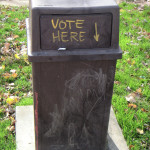
Vote HereSome of this nation’s greatest presidents are considered great because of their character. Certainly time has glossed over those mens’ faults, but the fact remains that for most of our history, one of the key qualifications sought for our highest office was character: integrity, diplomacy, strength in the face of adversity, moral uprightness. During my lifetime (though I don’t think it’s my fault!), character has slipped down the list of priorities.

Now I’m going to get very political: Donald Trump does not have the character to lead this country. His rhetoric is good media and an effective campaign tactic…if you’re trying to get free media coverage. Here’s the scary part: Trump claims that he’ll behave differently as president.

That’s not really how I’ll act.

Right or wrong, politicians have earned a reputation for being dishonest. Few reasonable adults believe the promises a candidate makes during a campaign—even if only because they recognize that the president has to work with a legislature that is often openly hostile to those promises.

We do, however, expect that what we see on the campaign trail will be what we see in the White House. Which brings up two glaring problems with Donald Trump: first, what we’ve seen from Trump during this campaign is not what I think we want to see in the White House. Leading this nation in the community of nations demands diplomacy and reason, not belligerent rhetoric.

Second, if the Donald Trump we’ve seen on the campaign is not the Donald Trump we would see in the White House, then we have no idea what President Trump would be like; we will have elected a ghost.

I’m scared. I’m scared because I don’t see a good candidate—a man or woman of character—who has a reasonable chance of becoming president. I’m scared because of the number of people who seem willing to put electability over character. And I’m scared because we might get exactly what we want in our next president—but not what we need. Character.

At the top, character counts.

Whether Good or Bad…part II

Share

Photo from http://www.prayforrefugees.com/

The Syrian refugee crisis has divided our country. Yes, a nation less than 2% the size of the US and over 7,000 miles away has divided us.

Some want to help the refugees—as long as they stay over there; some want to welcome them to the US with open arms; some want to ignore the crisis altogether, arguing that we have our own problems to worry about.

The crisis has divided the Church, too, and along similar lines. I’d like to say it is as simple as choosing fear or love, but nothing is simple.

What got me thinking about this now was my reading in Jeremiah 42. Nebuchadnezzar had ransacked Jerusalem and taken the best and the brightest back to Babylon. Those who remained asked Jeremiah the prophet to pray for them so that “God may show us the way we should go, and the thing that we should do.” (Given their track record of disobedience, it’s a wonder they asked at all.)

The word that came back from God was, shall we say, counter-intuitive. With Nebuchadnezzar still threatening, it certainly didn’t make them feel any better, either. In essence, God said, Don’t fight. Don’t be afraid. Don’t run away.

It wasn’t what they wanted to hear, and they didn’t obey.

I wonder how well we would obey. What if a prophet from God said to American Christians today, Don’t be afraid of the refugees. Welcome them to your country, your communities, your homes. Help them. Love them.

“But terrorists may come in, too!” we argue.

“Yes, I know,” replies God.

“But they’ll live off our taxes and get medical care for free!” we complain.

“Yes, I know,” God says. “Don’t be afraid. Welcome them. Help them. Love them.”

Sometimes what God says doesn’t make sense. It isn’t safe. It doesn’t seem right. That’s when faith comes in. That’s when obedience comes in.

Because disobedience isn’t safe, either.

Whether Good or Bad…

Share

freely-10163“Whether it is good or bad, we will obey the voice of the LORD our God to whom we are sending you, that it may be well with us when we obey the voice of the LORD our God.” (Jeremiah 42:6)

How often have you made promises like that? Usually they come out in the hard times—illness, unemployment, battles. When God seems distant, silent, even uncaring, and we’re desperate for something—anything—to let us know He hasn’t abandoned us.

But the promise made in the desert is always harder to keep in the lush, green meadow. Especially when the message we hear back isn’t quite what we had in mind. When God says to the suddenly-unemployed businessman, “don’t send out anymore resumes.” When He says to the couple desperate for children, “don’t adopt.” When He says to the cancer patient, “don’t try another treatment.”

Not long after Nebuchadnezzar had ransacked Jerusalem and deported the best and the brightest, those who remained sought God’s voice. We’ll do whatever He says, they vowed. It wasn’t an easy promise for the people of Israel, especially in light of what God had usually said through his prophet. And the message that came back was no different than before: Don’t be afraid. Don’t fight. Don’t run away.

But with the Babylonian king still on their doorstep, they didn’t like that message. And they didn’t keep their promise. But God did.

If they had just listened and obeyed, all would have been well. “I will build you up and not pull you down;” God said, “I will plant you, and not pluck you up; for I relent of the disaster that I did to you.” Instead, they ran away to Egypt—and Nebuchadnezzar followed. To borrow a line from The Phantom of the Opera, “disaster beyond your wildest imagination will occur!”

When I was in Liberia several years ago, many of the Christians shared a litany:

In that West African nation ravaged by a 14-year civil war, it was as much a statement of faith as of experienced reality; it didn’t feel like God was good all the time. But sometimes, faith is all we can cling to.

Sometimes, what God says doesn’t make sense. Sometimes, it seems to work against the very thing we want. Those are the times that faith is tested. That’s when faith gets real. That’s when we need to cry out in desperation, faith, and hope: God is good—all the time!