
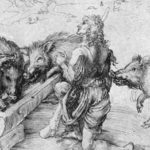
Alone With The Pigs

Share

(This is Part 2 in a story of the prodigal son. Read Part 1 here.)

The desert was no place for a man in silk. Blowing sand pierced the fine cloth, peppering his skin. It stung his unprotected eyes, burned his face.

Weak, hungry, alone, he cursed the sand and wind, cursed the city that mocked him, cursed the useless silk, cursed his birth. He cursed his father’s birth to the pastoral life from which he’d run. An unfamiliar odor assaulted his sand-whipped nostrils; he cursed the stench. Then, through squinted eyes he saw it: a herd of swine, their irritated squealing riding the wind toward him. He cursed the unclean beasts even as he hoped the drovers might spare him some bread.

“For a price,” they said. “Stay with this swine this night. What they don’t eat is yours.”

This night became two, then five, then a month. The famine that starved the land tore at his stomach. He watched in vain hope that the pigs would leave more than scraps, but even their rations were meager and their owner dared not feed them less; even in famine, no one wanted to buy a skinny pig.

Finally, lying awake, cold, and hungry in the desert night, sense came to him. The life he’d so longed to escape—the animals always needing care and feeding, the constant repairs to fences and troughs, the bucolic boredom—these were again his lot … minus the plentiful food on his father’s table. Even the ranch hands ate better than he ate now.

But how could he return? How could he possibly face again the father whom he had all but declared dead when he demanded his inheritance? Could he humble himself before the man he had so humiliated? Yet nothing could be more humiliating than his present state: silk rags torn and stained, body reeking of pig dung, hair and beard filthy and matted. It was decided then; he would return, fall on his knees, and beg for employment as a ranch hand.

It hadn’t been hard to leave that day, so many months before. It wasn’t hard to leave this day, either.

Part 3 coming soon….
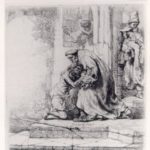
It Wasn’t Hard to Leave That Day

Share

It wasn’t hard to leave that day. The conversation was awkward—”Dad, I want my share. Now, please.”—but walking away wasn’t hard. There wasn’t much to take; less to leave behind. He’d never fit, anyway. The work, the animals, the quiet but grueling life of a nomadic sheepherder. Adventure called, and the city they’d passed two days earlier. No, it wasn’t hard to leave that day.
He’d sold his share of the flocks and with the silver weighing down his bag, turned his face toward the city. Soon, having traded his bedouin robe for city silks, he sought new life in the strangely solid buildings. Friends were easy to find; wine, an enticing invitation. Never again would loneliness sit heavy in his heart. Little did he know that his dark, herdsman’s skin and heavy purse betrayed his ignorance and innocence. Had he known, he would only have worked harder to win the friendship of ones already willing to drink from his bottle. He slept little, and never alone.

Far away, another man also slept little, his aloneness magnified by the vastness of the familiar night sky. At first light he scanned the horizons. Each setting sun darkened his hope a little more. 

The endless city noise grew deafening. The constant press of people—even the women sharing his bed—only magnified the loneliness he tried constantly to escape. The wine only made him forget last night; morning carried memories of home – and the love he’d never acknowledged. Day by day, his purse grew lighter. When it was at last empty, so were his bed and table. No face in town knew his; no familiar face did he see. Alone. Again.

The flocks grew, replenishing the loss of the too-soon divided inheritance. But even as the pens filled to bursting, so the father’s broken heart spilled out its last hope. Still he watched….

It wasn’t hard to leave that day. What was hard was knowing which way to go. The city spurned him, its lights and sounds betraying the emptiness of a false life—and revealing his own emptiness. No, it wasn’t hard to leave that day.

(to be continued…)

Leaning On The Bier

Share

We spoke of death quite easily
When you were only old
But health was yours
And theory checked our fears

We spoke of When, not If, but still
The When was down the road
And years were yours
And time, it checked our tears

Now When is feeling imminent
And hearts are breaking down
And words are hard
When leaning on the bier

Drought Resistance

Share

But blessed are those who trust in the LORD
and have made the LORD their hope and confidence.
They are like trees planted along a riverbank,
with roots that reach deep into the water.
Such trees are not bothered by the heat
or worried by long months of drought.
Their leaves stay green,
and they never stop producing fruit.
(Jeremiah 17:7-8, New Living Translation)

What does it look like to “trust in the Lord”? What does it mean to make him your “hope and confidence”? I’ve been wrestling with those questions over the past couple days – ever since my Dad reminded me of Jeremiah’s words.

Part of the answer lies in the alternative: trusting in “mere humans” and relying on human strength. Do that, Jer’ says, and you’re cursed. Not necessarily damned, but certainly doomed. Like a “stunted shrub in the desert… in the barren wilderness, in an uninhabited salty land.” With “no hope for the future.” Dismal words. Dismal picture. Dismal life.

“But,” he says, it doesn’t have to be that way. You can be like a riverside tree, “with roots that reach deep into the water.”

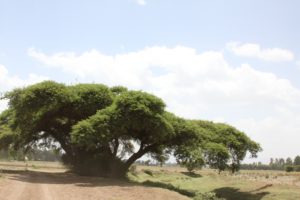
Look at the picture above. The landscape looks pretty brown and barren. Lots of weeds, but no crops. But the tree is flourishing. Green, leafy, healthy. Why? Because down to the right of the trunk, below the canopy’s shade, is a river. Not much of a river here, but water, nonetheless. And the tree’s roots reach through the brown soil deep into the ground where the water sits.

This particular tree, a few miles west of Ethiopia’s capital city, is a prayer tree. Christians from nearby villages meet here to pray in its cooling shade. In the midst of a dry and weary land, they come together to put their trust in the Lord; to make him their hope and confidence. And they—like the tree—aren’t afraid of the drought, but stay green and fruitful.

I’ve been through some wilderness times. I feel like I’m in the wilderness now. But there’s something different this time. More than ever before, I know I can trust in God. I know he is worthy of my trust, hope, confidence. It’s not easy; I’d really like to be able to just move forward, to pop out one more resume and get the job I’ve been waiting for, to be done with the waiting and wondering and wandering.

But he’s faithful. And even when I can’t see it, he’s growing fruit in me…and maybe even through me. And I don’t have to fear the drought.

Re:Connect and Re:Create

Share

A couple years ago I reconnected with a college friend. I was looking at a church’s website and saw an unusual, but familiar, name. Turns out it was my friend, now on staff at the church. It also turns out that she, like me, is a writer. Early this year, my friend invited me and a number of others to guest post on her blog with the theme, “Re:create.” Specifically, in her words, “we’re thinking about create with a healthy dose of play and how both can lead to transformation.”

My post combines several elements: a relationship that transformed how I view the Bible; an appreciation for God’s creativity; and a healthy dose of “sanctified imagination.” You’ll need to click over there to see what that means (at least until I post about it myself).

I’d love it, of course, if you would read my guest post on my friend’s blog, “Miracles in the Mundane.” But don’t stop there; look at some of the other things she’s written—like the story of her son deciding to grow his hair to donate for wigs for kids. Check out other guest posts (the “re:create” series will run most Wednesdays), like this one that offers some helpful insights into those pesky New Year’s Resolutions.

The blog can be found at https://milagromama.wordpress.com/.