
The Word: Written or Incarnate?

Share

Note: this post is more of a Bible study than most. If you are student of Scripture, then I would like your feedback on this. The perspective I present below is not the traditional evangelical view with which I grew up and in which I am trained, so I would like to hear from both my evangelical friends (who are likely to disagree) and with my friends from other theological backgrounds.

12 For the word of God is living and active, sharper than any two-edged sword, piercing to the division of soul and of spirit, of joints and of marrow, and discerning the thoughts and intentions of the heart. 13 And no creature is hidden from his sight, but all are naked and exposed to the eyes of him to whom we must give account. (Hebrews 4:12-13, ESV)

How do these oft-memorized verses about “the word of God” fit with the themes of entering His rest, of belief and obedience? And how do these verses connect those themes to the following passage about Jesus being the great high priest?

“The word” in verse 12 here is most often understood to be God’s recorded word, the Scripture; i.e., the Bible: God’s word (and words) revealed through His prophets, His Son, and the apostles; and written down and canonized.

This seems a too-limited view, however, in light of the words used and the context following. Certainly Scripture is sharp and piercing; it reveals our thoughts and intentions, shows whether we are truly obeying or merely acting. Yet this does not satisfy the descriptive words “living and active,” or the verb “discerning.” Verse 13, further, uses personal language: “sight” (can a written word see?); “him,” not it; and a personal direct object, “to whom” our account will be given.

I think verses 12-13 are speaking of the living Word of whom John wrote in his gospel: the Word-become-flesh, Jesus Christ. Certainly the writer here is not speaking exclusively of the written revelation (of which his own words would become a part).

Jesus Christ, the living Word of God, is alive and active, discerning, seeing, and waiting to receive an accounting of our belief or unbelief, our obedience or disobedience. It is Him to whom we owe our belief and obedience; Him to whom we will give account. He—not a book (even the Book of God)—is our great high priest, our mediator (1 Timothy 2:5) before God, and our salvation. It is through Jesus Christ that we may receive mercy when our hearts struggle to believe and grace when we disobey.

The Foundry

Share

“[Jesus] is the radiance of the glory of God and the exact imprint of his nature….” (Hebrews 1:3)

“For those whom he foreknew he also predestined to be conformed to the image of his Son….” (Romans 8:29)

I never got to use the sand-cast foundry in my high school’s Industrial Arts shop. Something was wrong with it, as I recall, so we could only talk about how it works, but that foundry came to mind when I read the opening words of Hebrews.

In sand casting, a pattern is pressed into a frame of compacted sand to create a mold. After removing the pattern, molten metal is poured into the mold. When the metal has cooled, the mold is removed from the completed casting, rough edges are smoothed off, and any other finishing work is done. All told, the process is extremely detailed, requires intense heat and pressure, and can develop imperfections at any point.

Kind of like being a disciple of Jesus.

I used to think Jesus was the pattern a disciple was supposed to follow. I don’t think that’s wrong, necessarily—Paul suggests it in Romans 8—but when I read these words in Hebrews recently, I had to do some new thinking. Hebrews says Jesus is “the exact image of [God’s] nature.” In a sand-casting analogy, that suggests that God himself is the pattern and Jesus is the mold – the sand that’s pressed around the pattern.

However you look at, there are some important lessons for us as disciples:

  • We are metal that gets melted down, both to be refined (see Zechariah 13:9 and Malachi 3:2), and so that we can be poured into the mold. Melting is hot and hurts, but it’s the only way to get rid of the impurities in the metal.
  • Even after we’ve cooled down and been removed from the mold, there’s still work to do. Scrap metal must be cut, chiseled, hammered, or torched off. Rough edges need to be filed down.

All these processes, in metalwork, transform a chunk of raw metal into a strong, useful, even attractive tool. In the Christian life, the process is called sanctification, transforming a stubborn, sin-riddled chunk of humanity into a new creation, a disciple shaped into the image of Jesus Christ – who is “the exact imprint of God’s nature.”

It’s a lifelong task. Where are you in the process? 

Whatever This Is

Share
He didn’t even spare his own Son –
	He’s not going to let that sacrifice go to waste!
What accusations? The answer is already
	on the table.
What condemnation? The penalty has already
	been paid. Over and done.
And now he’s at God’s side – has God’s ear.
	[Every mistake, every failing, every sin
		filtered through the prism of
		Jesus’ once-for-all sacrifice.
	Over before it’s done.]

So what!
	So what? So this:
		Nothing.
			NOTHING!
				NO-THING
		can come between me-and-him!

Hard stuff – really hard stuff?
		Nope.
Tears – piteous wailing – agonizing desperation? 
		Nope.
Faith-haters – faith-hurters – stone-hurlers? 
		Nope.
Empty stomach? Empty closet?
	Not those, either.

READ THIS:
	Because of You
		Death is daily, moment-by-moment
			Slow, torturous.
		We’re in line for the slaughterhouse.

But – however – nonetheless – yet…
		WAIT! Hold presses!
	Fooled ya’!
		We win! We win! We win!
			We won! You won!
	Your love — death-to-self, us-before-you,
		climb-up-on-the-cross-and-die-for-me love…
Your love won the fight, the battle, the war
	long before I even knew there was an argument.

And so, I know this — with every ounce of knowing,
	every fiber of my being,
	beyond the doubts that hide in shadows:

	Ain’t nothin’ comin’ ‘tween me and your love!
		Death – life
		Angels – kings – congress – presidents
		Now – not yet
		Enemies of the state
		Unclimbable mountains – unfordable valleys
		Stuff that's made

Nothing at all can come between
	me-and-your-love.

[Guess I can handle this*, huh?]


			*whatever “this” is

(Based on Romans 8:31-39.)

Can these dry bones live?

Share

It’s one of the odder scenes in the Bible: a valley of bones. Dry, sun-bleached bones. We don’t know why they’re there, or even where “there” is. We only know that God takes Ezekiel and sets him down in a valley filled with dry bones. Very dry.
But the odd isn’t over. God tells Ezekiel to speak—or rather, to prophesy—to proclaim God’s words to the bones. “Say to them,” God says, “‘O dry bones, hear the word of the LORD.'”

Ummm… God? Bones can’t hear. Especially dry bones. 

But isn’t that sort of the point? If the bones could hear, they wouldn’t be dry. Resurrection wouldn’t be resurrection without death.

We speak of “the miracle of modern medicine” – and I admit, it’s pretty amazing stuff. (My 80-year-old Dad had three major surgeries last year; I’m convinced.) But miraculous? Even Miracle Max knew that his “miracle pill” would only work because The Man in Black was just “mostly dead. … With all dead, well, with all dead there’s usually only one thing you can do: Go through his clothes and look for loose change.” (The Princess Bride)

Lazarus was all dead when Jesus called him from the grave. Jesus was all dead when God raised him that first Easter morning. And the dry bones were all dead. But that didn’t stop Ezekiel from prophesying.

What part of you is God bringing back to life?
Where is God’s breath blowing,
the dry bones moving?

Read Steve Garnaas-Holmes’ reflection (from which those questions come) at www.unfoldinglight.net. Then listen for the rattling of the bones. Listen for the wind (God’s breath, His Spirit; they’re all the same word). And, as Steve writes:

Be open to the miracle
Let God breathe, and wait.

Because even if you’re “all dead,” God can breathe life into your dry bones.

One Righteous Act

Share

Jesus asked his disciples, “Who do people say that I am?” And they said, “Some say John the Baptist, others say Elijah, and others Jeremiah or one of the prophets.” (Matthew 16:13-14, ESV)

If Jesus were to ask that same question today, the answers might be, a religious leader, a healer, or even a fake. He is often put on a level with Mahatma Gandhi as an advocate of peace; with Mother Teresa as a bringer of love; with Mohammed as a prophet. Most people who have any understanding of the historical Jesus say that he was, at the very least, a good teacher.

C.S. Lewis, of course, seeks to dispel that misconception by his famous “Lord, liar, or lunatic” argument (see the Preface to his book, Mere Christianity). His basic argument: given the incredible claims Jesus made about himself, he could only be a deluded lunatic, a pathological liar…or exactly who he said he was: Lord.

There is no doubt that Jesus was what so many believe of him: a good teacher, a prophet, a healer. He epitomized love for the outcast and spoke wisdom that shut the mouths of religious and political authorities alike. But if that is all he was, his impact on the world is all but over and done. Sure, his followers (most, anyway) continue to promote his message of love and peace, continue to seek the good of their communities and the world. But that’s about it. Hope ends there.

Recently I came across this verse: “…through one righteous act there is justification leading to life for everyone.” (Romans 5:18, Christian Standard Bible)

For some reason, those three words—one righteous act—stopped me in my tracks. Just one thing made the difference between a good but ultimately meaningless life, and a life of ultimate purpose and eternal impact.

What was that one righteous act? His death. The cross. 

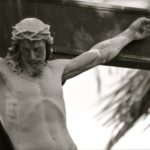
Sit with that thought for a few moments. It is, after all, Good Friday—the day Christians around the world remember Jesus’ sacrifice. We look forward to Easter, of course, but you can’t get to Resurrection Sunday without going through Good Friday. Or silent Saturday, a day of grieving, wondering, waiting…for God knows what? So just sit with the reality of the cross, of a torturous death.

Sit with the truth that, but for Jesus’ sacrifice, we would have no hope beyond this life (which, you have to admit, has been challenging the past few years). Just one righteous act made possible justification leading to life for everyone. Life. Justification—a big word that simply means the slate has been wiped clean.

Jesus’ one righteous act demands just one righteous act in return. To lay claim to that gift—life, justification—you need only believe.

If you confess with your mouth, “Jesus is Lord,” and believe in your heart that God raised him from the dead, you will be saved. (Romans 10:9-10, CSB)

Just one righteous act.