I have just started writing for a couple blogs, published by Logos Bible Software, which are geared toward current and prospective seminary students. My first post was just posted at best-seminary.com and, ironically, is titled, “Why You Shouldn’t Go To Seminary.” Now I need to hurry and finish a follow-up piece that will be titled, “Why You Should Go To Seminary”—before Logos decides they don’t want me writing anymore!
What I’m Reading: Under the Unpredictable Plant
Under the Unpredictable Plant: An Exploration in Vocational Holiness, by Eugene Peterson, is the third in a series of three books on the work of pastors in North America. (The other two titles are Working the Angles: The Shape of Pastoral Integrity
and Five Smooth Stones for Pastoral Work
, which sit on my bookshelf waiting to be read.)
If I had to choose a pastor after whom to model my ministry, it would be Eugene Peterson. He seems so much more concerned about his congregation’s toward maturity in Christ than about its growth in size. His writing is theological, sometimes philosophical, often eminently practical. Best of all, he offers no programs to sell, no models to follow; only sound, Biblical counsel.
In Under the Unpredictable Plant, Peterson uses the story of Jonah to help clarify the pastoral vocation in the midst of a culture that calls (and tempts) pastors to “religious careerism.” He uses Tarshish, Jonah’s destination of choice, as representing an exotic and far-away city where Jonah dreamed of doing big things for God (just not in God’s presence). Pastors today are similarly tempted by the culture to run to the next big, exciting church where they might do great things for God…and then get invited to speak at a conference or two. Ninevah, on the other hand, represents the heart of what God calls pastors to do: faithfully proclaim His message of love and grace to messy people.
Throughout his books, Peterson weaves pieces of his own story: growing up in a home with a Pentecostal preacher mother and a butcher father; childhood encounters with rough-edged farmers; struggling to make the language of the Bible real for an adult Sunday School class (the genesis—no pun intended—of his contemporary-English Bible translation, The Message). These personal stories bring Peterson’s philosophy and theology to life.
I would love to meet Eugene Peterson. I am almost jealous of a pastor friend who, with his wife, got to spend several days in Peterson’s home as a gift from his church! In fact, when looking into seminaries several years ago, Regent University in British Columbia was high on my list, precisely because that’s where Peterson was serving at the time. For now, though, I am content to be mentored vicariously through his books.
Unless you become like little children…
She prays her childlike prayers and I correct, seeking to bring maturity to her childlike faith. After all, she’s twelve, and I am old. And, I fear, ignorant.
She asks God to help her aunt not be sick; I ask Him to heal. She asks God to help China get more Bibles; I challenge her to buy Bibles for China. She asks God to help her have a good day at school tomorrow; I pray that she would bring Him glory in whatever comes her way. She asks God to do what He wants; I ask Him for what I want.
What am I doing, trying to make my little girl grow up? I should be asking her to teach me to pray!
“A little child will lead them.” Familiar words. Convicting words. Are they really in the Bible, or merely a slogan that sounds good? My old, mature, needs-to-know self searches: yes, there they are, in Isaiah 11:6. Then Jesus’ words come to my old, mature mind: “Unless you become like little children, you will never enter into the kingdom of heaven!” (Matthew 18:3)
Tonight, Abba, help me; help me learn from my little girl.
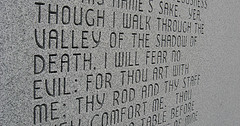
Looking for Normal in the Shadow of Death
A week ago I wrote here that I would post each Wednesday about a book I’m reading. Here it is Wednesday, and although I tried, I can’t. You see, last Wednesday—my first non-holiday, weekday off work in…I don’t know how long—I was hit with some fairly devastating news. Life and death news. And in a cruel twist of irony, I had just journaled that morning about another life and death: my brother’s. You see, last Wednesday was the eve of the 35th anniversary of my brother’s death by the cold hand of cancer. He was three months and four days shy of his 18th birthday; I was 16. Rick died the Wednesday before Palm Sunday. Last Wednesday was the Wednesday before Palm Sunday.
Holy Week—what Christians call the week from Palm Sunday to Easter Sunday, the last week of Jesus’ life—is a time of joy and anticipation, celebrating the resurrection of the one we believe conquered death, sin, and Satan. The joy is interrupted for about thirty-six somber hours as we remember His brutal and senseless death at the hands of jealous religious leaders and a gutless Roman puppet governor, but it returns with the first rays of the sun on Easter morning as we cheerfully share the greeting, “He is risen! He is risen indeed!”
I don’t recall a thing about Holy Week 1980. I certainly don’t recall much joy, but I know the somber hours of mourning lingered far beyond a mere day-and-a-half as Rick’s death cast a long, dark shadow that even Jesus’ resurrection couldn’t seem to erase.
Now here I am again in the middle of Holy Week, and the shadow of another death darkens the days. Not a death-in-the-past this time, but the expectation of one that will come too soon, too young; a death I anticipate and dread, that I strive to hold off, pray against, fight against, beg God to forestall. Yet in the midst of the foreboding shadow of death, life goes on. I go to work with unknowing coworkers. My kids go to school with blissfully ignorant classmates. On the freeway, at the gas station, in the grocery store…even at church I cross paths with people who don’t see the shadow, whose own lives may be bright with the joy of new birth or darker even than my own. And each day I seek a sense of normalcy.
This week, especially, I want to know the celebration of Jesus’ Triumphal Entry. I want to join in on His last Passover meal with His best friends. I want to feel the weight of Peter’s denial and the long, piercing thorns of the “crown” pressed into Jesus’ scalp. I want to wake up on Easter morning and wholeheartedly proclaim, “He is risen! He is risen indeed!” Instead, I am voicing the same accusation both Martha and Mary leveled at Jesus when Lazarus died: “Lord, if you had only been here….”
And Jesus wept. And I weep. And our tears flow together. And maybe that, for now, is the most normal thing about the shadow of death: Jesus is present with me, weeping with me.
The Faith of Community
Directly across from me, leaning back against a tree, sat the family patriarch. He looked 75 but was likely 15-20 years younger. Around us sat his family – young children, teenagers, and a few perhaps in their early 20s. My hosts brought me a small stool on which to sit, and for the next 30 or 40 minutes we talked about my faith and theirs, the Bible and the Q’ran, about Jesus and Islam. Several times, the patriarch – I never got his name – told me, “What you say is good.” As we concluded our conversation he invited us to return the next day to talk more, but with regret I explained that this was our last day in the area. Repeating his affirmation, “what you say is good,” he added, “We will believe, me and my family. Not today, but probably in two or three days, we will believe.”
This encounter took place ten years ago this past week, in a village in southern Ethiopia. Two days later, the team I was with flew home, spending Easter morning on a layover at Frankfurt International Airport in Germany. My mind often returns to that village and the twice-translated conversation with the family. Did the life-giving resurrection of Jesus Christ take place in their hearts? If I were to return to the village today, would it still be dominated by Islam, or would the patriarch—or one of the children sitting with us in the shade of the tree—be leading a ten-year-old church? For a decade I have longed to return and to meet this man and his family again. Maybe someday I will.
Across the barriers of language, I learned something under that tree that has shaped my life, my faith, and my ministry as a pastor: faith is not a do-it-yourself encounter. We do not come to faith, profess faith, walk in faith, grow in faith, or live in faith alone. Faith is a community affair. It is conceived, born, and nurtured in community. It grows and matures in community. It lives and thrives in community.
This challenges much of what I was taught growing up, which centered on making a personal decision for Christ, a personal confession of faith. This notion of individualized faith, while not theologically incorrect, is at best incomplete. Scripture is filled with stories of households and communities that believed in Jesus…apparently as one, at one time. When Jesus met the Samaritan woman at a well and told her everything about her, she believed; then she went back to her village and told them about Him, and they believed. (Read the encounter in John 4.) When Peter and a Roman centurion named Cornelius each had a vision directing them to meet, Peter shared the good news of Jesus and “the Holy Spirit fell on all who heard the word” (Acts 10). Or read of the conversion of Lydia in Philippi (Acts 16) or Crispus in Corinth (Acts 18).
I don’t know all the implications of this community faith idea. It certainly doesn’t absolve any individual of confessing Jesus for himself or herself. Nor, I think, does it mean that children raised by Christian parents get a free pass into heaven. (These concepts of “fire insurance,” “ticket to heaven,” “get out of hell free” … they’re all really bad theology, anyway; they completely miss the point of Jesus’ life, death, and resurrection. But that’s a subject for another post.) Maybe this would be a good opportunity for you to share some thoughts. What implications do you see for yourself, your family, your church, your work, other people in your circles of influence?